
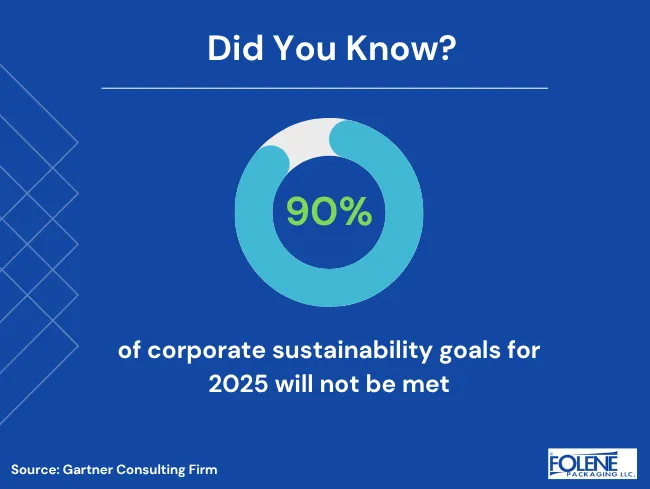
Many companies are committed to sustainability- at least on paper- but Gartner consulting firm reveals that a shocking 90% of corporate sustainability goals for 2025 will go unmet. Brands that previously made sweeping sustainability change promises are trying to graciously backpedal as the reality of implementing these changes turns out to be much more difficult than anticipated. Folene Packaging analyzes this trend of unmet sustainability goals and breaks down the necessary components for setting achievable corporate sustainability goals.
Failed Sustainability Goals
Recently, many noted brands like Coca-Cola face backlash for scaling back their plastic sustainability goals. Unilever originally pledged to cut new plastic use in half by 2025, but admitted that is unlikely to happen; they are now aiming to reduce new plastic use by one-third by 2026. Here are some other big brands that fell short of their sustainability goals:
Brand | Original Sustainability Goal | New Sustainability Goal |
|---|---|---|
Unilever | Halve use of new plastics by 2025 | Reduce new plastic use by one-third by 2026 |
PepsiCo | 100% recyclable, compostable, or reusable packaging by 2025 | Achieve 92% of packaging target by 2030 |
Colgate-Palmolive | 100% technically recyclable, reusable, or compostable packaging by 2025 | Net-zero carbon emissions by 2040, and 100% renewable electricity for its global operations by 2030 |
Walmart | Transition to recyclable, reusable, or compostable packaging and use post-consumer recyclate by 2025 | Decarbonizing global operations by 2040 |
Coca-Cola | 25% reusable packaging by 2030 |
|
Why Many Companies Fell Short of Their Corporate Sustainability Goals
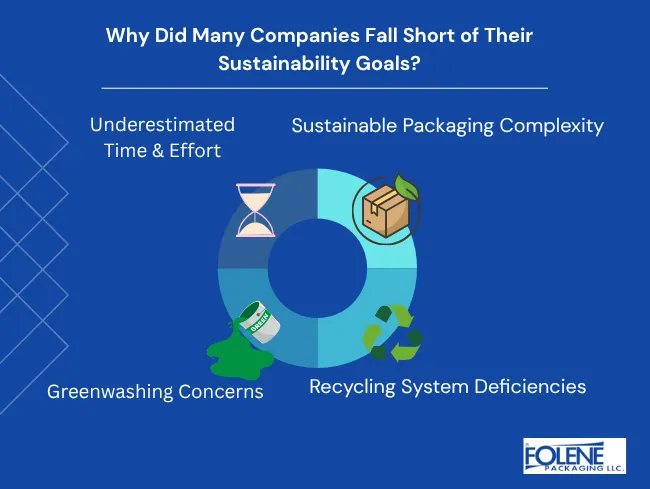
Several factors have contributed to why many companies struggled to meet their ambitious corporate sustainability goals, particularly in the area of sustainable packaging.
Complexities of Sustainable Packaging
Redesigning packaging to be truly compostable, recyclable, or reusable is a complex challenge. It requires not only innovation in materials but also the development and implementation of infrastructure to support these new packaging types. This process is proving to be more time-consuming and difficult than many companies initially anticipated, slowing progress toward their sustainability targets.
Deficiencies in Recycling Systems
Another significant hurdle is the inadequacy of existing recycling systems. Many recycling facilities are not equipped to handle the growing volume and diversity of materials used in sustainable packaging. This limits the effectiveness of recycling efforts and undermines companies’ ability to achieve their goals related to recyclable or compostable packaging.
Underestimation of Time and Effort
Many companies underestimated the extensive time and effort required to roll out sustainable packaging solutions throughout their entire supply chains. Coordinating with suppliers, manufacturers, and distributors to ensure compliance and effectiveness across all stages is a complex endeavor that often takes longer than planned.
Greenwashing Concerns
Additionally, some companies have faced scrutiny over their sustainability claims, with accusations of greenwashing—exaggerating or misrepresenting their environmental efforts. This has led to increased skepticism from stakeholders and the public, putting additional pressure on companies to deliver measurable progress and transparent corporate sustainability reporting.
Understanding these challenges is essential for setting more achievable corporate sustainability goals and fostering responsible business conduct that aligns with stakeholder expectations and contributes positively to environmental performance and social responsibility.
Developing Acheivable Corporate Sustainability Goals
Develop a clear and comprehensive corporate sustainability strategy that includes specific, measurable, achievable, relevant, and time-bound (SMART) sustainability goals. Here are several key steps towards creating viable sustainable practices
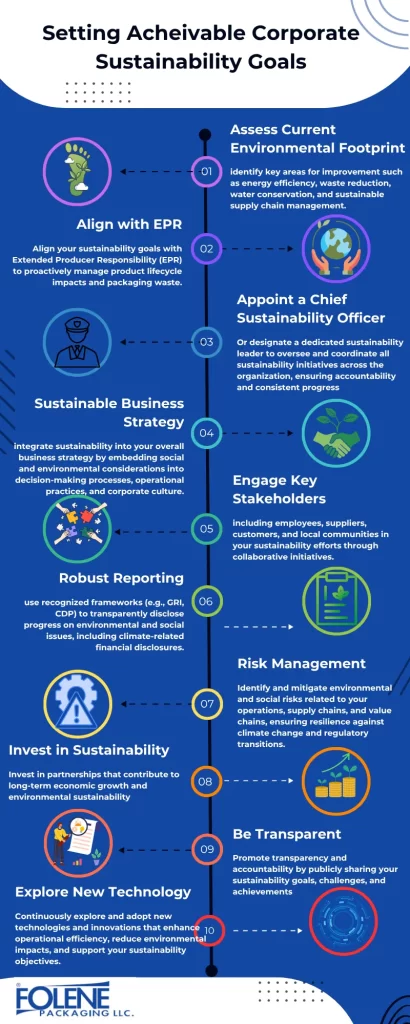
Conduct a thorough assessment of your company’s environmental footprint, identifying key areas for improvement such as energy efficiency, waste reduction, water conservation, and sustainable supply chain management.
Align your sustainability goals with Extended Producer Responsibility (EPR) regulations applicable in your state. If your state does not yet have EPR requirements, consider voluntarily adopting EPR principles to proactively manage product lifecycle impacts and packaging waste.
Appoint a Chief Sustainability Officer (CSO) or designate a dedicated sustainability leader to oversee and coordinate all sustainability initiatives across the organization, ensuring accountability and consistent progress.
Integrate sustainability into your overall business strategy by embedding social and environmental considerations into decision-making processes, operational practices, and corporate culture. Implement sustainable business practices such as using recycled materials, reducing single-use plastics, optimizing logistics for lower carbon footprint, and increasing energy efficiency across facilities and data centers.
Engage key stakeholders—including employees, suppliers, customers, and local communities—in your sustainability efforts through transparent communication, community engagement programs, and collaborative initiatives.
Establish robust corporate sustainability reporting practices using recognized frameworks (e.g., GRI, CDP) to transparently disclose progress on environmental and social issues, including climate-related financial disclosures. Set up a system for continuous monitoring, evaluation, and improvement of sustainability efforts, regularly reviewing goals and adapting strategies based on measurable progress and emerging environmental and social issues.
- Prioritize risk management by identifying and mitigating environmental and social risks related to your operations, supply chains, and value chains, ensuring resilience against climate change and regulatory transitions.
Support sustainable investments and partnerships that contribute to long-term economic growth, environmental sustainability, and social responsibility, reinforcing your company’s reputation and competitive advantage.
Promote transparency and accountability by publicly sharing your sustainability goals, challenges, and achievements, building trust with customers, investors, and other key stakeholders.
Continuously explore and adopt new technologies and innovations that enhance operational efficiency, reduce environmental impacts, and support your sustainability objectives.
Align short-term business priorities with long-term sustainability goals to ensure that immediate actions contribute positively to future generations and the health of the planet.
Corporate Governance and Sustainability
Corporate governance plays a critical role in advancing sustainability efforts, and appointing a Chief Sustainability Officer (CSO) is essential to ensure that these initiatives are managed effectively and transparently. The CSO leads the integration of the three pillars of corporate sustainability—environmental, social, and governance—into the company’s overall strategy, setting clear sustainability goals, monitoring progress, and overseeing comprehensive reporting on sustainability initiatives. By having a dedicated leader focused on sustainability, companies are better equipped to align their operations with responsible business practices, manage transition risks, and seize emerging opportunities, ultimately driving long-term value and reinforcing their commitment to social and environmental responsibility.
Environmental Sustainability and Climate Change
Environmental sustainability is a vital pillar of corporate sustainability, demanding that companies actively work to reduce their environmental footprint as part of their broader corporate sustainability goals. By adopting eco-friendly practices such as utilizing renewable energy sources, minimizing waste generation, and improving energy efficiency, businesses can significantly lessen their environmental impacts. Addressing environmental concerns is not only crucial for mitigating climate change—a pressing global issue that threatens ecosystems and communities worldwide—but also for fostering long-term economic growth and resilience.
Companies that prioritize environmental sustainability contribute to the transition toward a low-carbon economy, reducing reliance on fossil fuels and promoting the responsible use of natural resources. Moreover, integrating these practices into a comprehensive corporate sustainability program allows organizations to manage transition risks effectively, enhance their reputation, and meet growing stakeholder expectations related to social and environmental impacts. Through continuous innovation and transparent corporate sustainability reporting, businesses can demonstrate measurable progress in their sustainability efforts, reinforcing their commitment to corporate responsibility and socially responsible practices.
Ultimately, embedding environmental sustainability into a company’s core values and operations not only helps protect the planet for future generations but also drives business success by aligning with global trends and regulatory frameworks focused on combating global warming and preserving natural resources.
Corporate Sustainability Reporting
Corporate sustainability reporting is essential for transparency and accountability, requiring companies to prioritize detailed and accurate disclosure of their sustainability efforts. Effective reporting should encompass comprehensive information on environmental and social impacts, as well as measurable progress toward established corporate sustainability goals. To ensure consistency, comparability, and credibility, companies are encouraged to adopt recognized standards such as the Global Reporting Initiative (GRI) or the Carbon Disclosure Project (CDP).
Emerging Extended Producer Responsibility (EPR) regulations are playing a pivotal role in driving improvements in data collection and reporting practices. These regulations hold producers accountable for the entire lifecycle of their products, incentivizing companies to enhance their tracking of resource use, waste generation, and recycling outcomes. As a result, businesses are investing in more robust data management systems and analytics to accurately monitor their environmental footprint and demonstrate compliance. By embracing these regulatory frameworks, companies not only fulfill legal obligations but also strengthen stakeholder trust and reinforce their commitment to responsible business conduct and sustainability transparency.
Continuous Improvement and Sustainability
Continuous improvement is a fundamental component of successful corporate sustainability efforts, serving as the engine that drives ongoing progress and adaptation in sustainable business practices. By prioritizing regular monitoring and evaluation, companies can effectively identify areas where their sustainability initiatives may be falling short or where new opportunities for enhancement exist. This proactive approach involves setting clear, measurable sustainability goals and consistently tracking progress against these benchmarks to ensure accountability and transparency.
Moreover, comprehensive reporting on sustainability initiatives not only demonstrates a company’s commitment to responsible business conduct but also builds trust with stakeholders, including customers, investors, and employees. Embedding a culture of continuous improvement encourages innovation and responsiveness, enabling businesses to adapt to emerging environmental and social challenges while maximizing positive impacts. Ultimately, this dedication to ongoing refinement fosters long-term value creation, positioning companies to achieve sustained success by aligning their operations with evolving sustainability standards and stakeholder expectations.
How Folene Packaging Supports Achieving Corporate Sustainability Goals
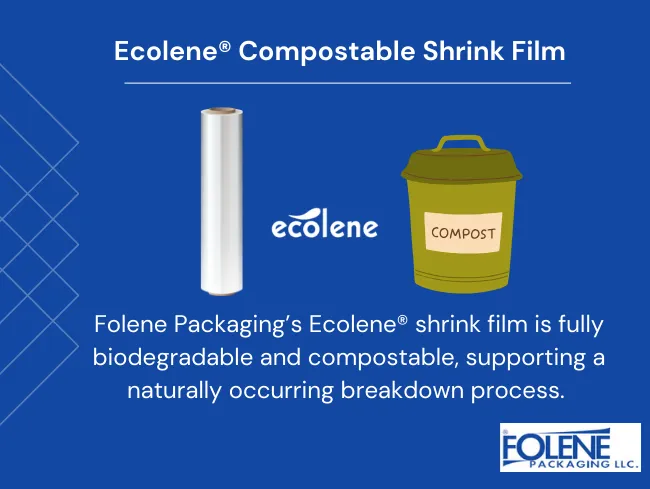
Folene Packaging offers innovative solutions that empower brands to meet and exceed their corporate sustainability goals through their advanced line of high-performance shrink films. These films are designed with sustainability at their core, featuring fully recyclable, biodegradable, and high post-consumer recycled (PCR) content materials. By choosing Folene Packaging’s shrink films, companies can significantly reduce their environmental footprint while maintaining packaging quality and durability.
Their fully recyclable films help brands contribute to reducing waste and improving circularity in packaging, aligning with growing consumer and regulatory demands for eco-friendly packaging solutions. The biodegradable options provide an alternative for brands seeking to minimize their impact on landfills and natural ecosystems, ensuring that packaging materials break down more rapidly and safely.
Moreover, Folene’s high PCR content films support the use of recycled materials, promoting resource conservation and reducing reliance on virgin plastics. This approach not only helps companies meet sustainability criteria but also demonstrates a commitment to respecting human rights and fair labor practices by supporting responsible supply chains.
By integrating Folene Packaging’s sustainable shrink films into their packaging strategies, brands can advance their corporate sustainability initiatives effectively. These products enable measurable progress in reducing waste, lowering carbon footprints, and enhancing overall environmental performance, all while supporting the company’s values and long-term economic growth. Folene Packaging thus serves as a trusted partner in helping companies operate responsibly and transparently, contributing positively to social and environmental issues through innovative, sustainable packaging solutions. Contact our sustainable packaging experts today to take a step in the right direction.